Car Rental Growth Isn’t About More Cars — It’s About Smarter AI Workflows
I share insights on Software Development, Data Science, and Machine Learning services. Let's explore technology together!
Scaling a car rental business in 2026 is no longer about adding more vehicles to your fleet. The real competitive edge now comes from operational intelligence powered by AI workflow automation.
With the global car rental market projected to approach $247.7 billion by 2034, the gap between industry leaders and struggling operators will be defined by efficiency — not inventory size. Manual operations are quietly draining revenue, while AI-driven systems are transforming how modern rental companies scale, optimize assets, and improve profitability.
Predictive maintenance alone can reduce maintenance costs by up to 40% and cut fleet downtime by nearly 50%. Meanwhile, dynamic pricing models can boost fleet utilization by 15%, proving that the future of car rental is increasingly “software-defined.”
So what exactly are the AI workflows reshaping the industry?
Top AI Workflow Automation Strategies to Scale Your Car Rental Operations
Press enter or click to view image in full size
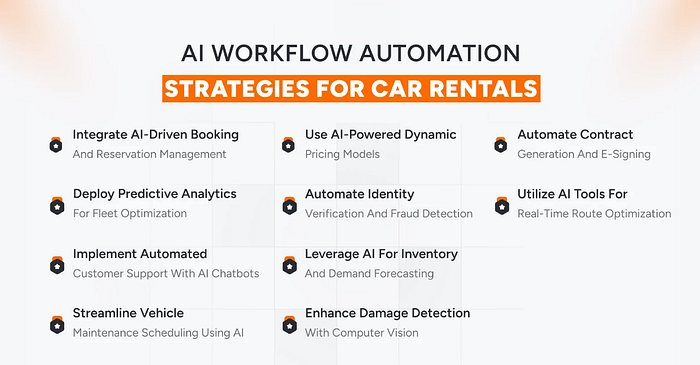
Scaling car rental operations in a dynamic market requires moving beyond simple digitization to a “software-defined ecosystem” where AI drives decision-making and efficiency. Here are some of the top AI workflow automation strategies to scale your operations.
1. Integrate AI-Driven Booking and Reservation Management
Modern artificial intelligence in the care rental business goes beyond rigid scripts to create fluid, self-service booking experiences. By integrating AI-driven reservation systems, you can automate complex booking workflows that adapt to real-time inventory and customer needs.
AI integration can help your car rental business.
Operational Impact: AI algorithms can predict demand patterns to optimize vehicle availability and handle bookings without human intervention, significantly reducing manual errors.
Conversational Interfaces: Advanced platforms now use generative AI to conduct natural dialogues, allowing customers to modify reservations or ask specific property questions in their own words.
Seamless Handover: Automation enables “wireless-first” rentals where customers locate and unlock vehicles via mobile apps, bypassing the rental counter entirely and reducing staffing costs at high-traffic locations like airports.
2. Deploy Predictive Analytics for Fleet Optimization
To scale efficiently, operators must maximize the utilization of their most expensive assets. AI-powered fleet management and optimization tools analyze real-time data to align fleet size and location with actual needs.
Asset Placement: AI analyzes historical usage, seasonal trends, and local events to optimize vehicle distribution across depots. This “load-aware” distribution can improve inter-depot move speedsand reduce unnecessary mileage.
Utilization Analysis: AI identifies underutilized vehicles and recommends retirement or reallocation, ensuring the fleet is “right-sized” for current market demand.
3. Implement Automated Customer Support with AI Chatbots
AI chatbots and virtual assistants provide 24/7 support, ensuring no booking opportunities are missed due to office hours or high call volume.
Productivity Gains: By instantly answering FAQs regarding pricing, policies, and availability, AI agents can reduce staff workloads and boost overall productivity.
Omnichannel Presence: These agents handle inquiries across WhatsApp, SMS, and web platforms simultaneously, meeting customers where they are and reducing resolution times.
Contextual Assistance: Tools like Booking.com’s “AI Rental Helper” simplify the experience by instantly explaining terms and conditions or insurance details.
4. Streamline Vehicle Maintenance Scheduling Using AI
Transitioning from reactive to predictive maintenance is critical for scaling fleets without ballooning repair costs.
Predictive Capabilities: Machine learning models analyze real-time telematics data to predict engine failures accurately.
Cost & Uptime Benefits: This proactive approach can reduce breakdowns and maintenance costs, while also minimizing downtime by scheduling repairs during planned idle periods rather than waiting for a failure.