Vue vs React: The Frontend Battle No One Can Agree On
I share insights on Software Development, Data Science, and Machine Learning services. Let's explore technology together!
Developers love debating Vue vs React — almost as much as they love tabs vs spaces. Both frameworks power millions of modern apps, both deliver rich UIs, and both have fiercely loyal communities.
Yet choosing the right one for your project?
That’s where teams get stuck.
React dominates the web, with 5x as many JavaScript websites.
Vue counters with a cleaner, more integrated ecosystem.
So who actually wins?
Let’s break down the real difference — without the hype — so you can make the smarter choice for your next build.
A Quick Snapshot: Vue vs React
If you just want the TL;DR of their personalities:
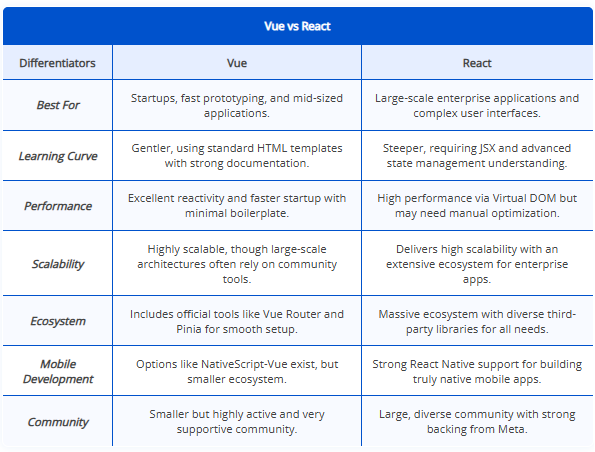
Both are great. Both are powerful.
But they’re built for very different kinds of teams and products.
What is Vue?
Press enter or click to view image in full size

Vue is a lightweight JavaScript framework that provides advanced web development tools for building modern single-page applications. It is one of the most versatile and progressive frameworks, allowing you to create app code without developing any core features. This means you can make a progressive UI. Plus, it supports high decoupling, enabling you to extend a web app’s functionality with customized modules and visual components.
Leveraging the VueJS development, you can create,
PWAs and SPAs
Large-scale enterprise apps
Extend the existing app function
For any CTO, Vue offers the following differentiators compared to React,
You can use Vue as a jQuery replacement without rewriting the whole system.
You can scale up Vue to handle complex single-page applications by leveraging its advanced build chain and ecosystem.
Market Usage And Adoption of VueJS
Market Share: Vue powers approximately 19.2% of the frontend framework market, with usage on over 3.5 million websites globally.
Developer Retention: The State of Vue 2025 report indicates extremely high satisfaction, with 93.4% of developers stating they would use it again.
Downloads: It averages 6.4 million weekly downloads on NPM.
Enterprise Validation: It is currently used in production by industry giants, proving its stability for large-scale workloads:
Netflix (internal dashboards/tools)
Apple (various web properties)
Nintendo (loyalty programs/sites)
GitLab (entire frontend is Vue-based)
BMW, Adobe, and UpWork
What is React?
Press enter or click to view image in full size

React is an open-source JavaScript library for building user interfaces, originally developed and maintained by Meta (Facebook). It uses a component-based architecture and a virtual DOM to update and render UI elements efficiently.
This modular design makes React extremely flexible and performant, ideal for modern dynamic web apps. The library focuses on declarative rendering: you describe what the UI should look like, and React updates the DOM as the underlying data changes.
This results in fast, responsive interfaces suitable for complex, data-driven applications.
Leveraging React development, you can create:
Progressive Web Apps (PWAs) and Single-Page Applications (SPAs): React’s virtual DOM and client-side routing make it easy to build fast, interactive SPAs and mobile-friendly PWAs.
Large-scale enterprise applications: With frameworks like Next.js and robust state management libraries, React scales to support complex, enterprise-grade web platforms.
Enhance existing apps: React can be introduced incrementally (e.g., by rendering individual components on a page), enabling you to modernize parts of a legacy application without a complete rewrite.
For any CTO, React offers the following differentiators compared to Vue (and other frameworks):
Massive ecosystem and corporate backing: React is supported by Meta and a vast ecosystem of tools and libraries (such as Next.js for server-side rendering, Gatsby for static sites, and React Native for mobile). This robust ecosystem means solutions exist for nearly every use case and ensures ongoing innovation.
Broad industry adoption and talent pool: React is the de facto choice for many companies, so there is a large community and job market. This makes it easier to hire experienced developers and leverage community-built components. It’s a one-way data flow, and virtual DOM also gives predictable performance under heavy load, which is attractive for large applications.
Market Usage And Adoption of React
Market Share: React is the clear leader among front-end frameworks. On the web, React is used by about 6–7% of all websites (and 7.7% of sites that use any known JavaScript library), making it one of the most widely deployed JavaScript libraries today.
Developer Adoption: Surveys consistently rank React as the most popular and in-demand frontend framework.
Downloads: React is widely used on package registries. Its core npm package receives over 20 million downloads per week.
Enterprise Validation: React’s stability and scalability are proven by its use in production at many global companies. Industry leaders leveraging React include:
Meta Platforms (Facebook, Instagram)
Netflix
Airbnb
Uber
Dropbox
Atlassian’s Jira/Confluence
Salesforce’s Lightning
Now that you know what Vue and React are individually, let’s understand the core differences between them in detail.